Fruit Tree Pruning Philosophy
We love fruit trees, and we understand that fruit trees often carry a sentimental value to their owners. When pruning a fruit tree, it is vitally important to the health of the tree (and also to ensure bountiful harvests) that no more than 25% of the tree’s leafy canopy be removed in a single year, since the leaves are the food factories of the tree. Pruning excessively in one session will cause the tree to ‘starve’, become distressed, and send out an emergency response which appears as unsightly water sprouts that are weakly attached and can even become dangerous. We mostly utilize many smaller diameter thinning and reduction cuts. When it is absolutely necessary, we plan larger diameter reduction cuts considering the species and condition of the tree. The end result is a tree with a canopy that is well balanced and encourages good light penetration and air flow.
Why are balance, light and air important?
Trees benefit from a canopy that allows sunlight and fresh air to penetrate evenly. A well balanced canopy will shed stresses like rain, snow and especially wind better than a canopy that is lopsided. Adequate infiltration of light and air is needed to keep the leaves, branches, and trunk from experiencing excessively moist conditions which can lead to pest and disease problems. Also, and just as important, fruit require exposure to sunlight in order to ripen properly.
Annual Pruning
Fruit trees benefit most from an annual pruning cycle: each year just a little is removed to keep the trees from growing unruly and unhealthy. We have found that annual pruning of fruit trees is the best cultural method for promoting tree health, which in turn encourages better harvests and also keeps pest and disease issues under control.
The 5 D’s of Good Pruning
- Diseased
- Damaged
- Deadwood (larger diameter that poses a risk)
- Duplicate
- Directionally Challenged
We will explain our approach to the 5 D’s in more detail at your on site consultation for an estimate, and answer any questions that may arise.
Cultural Controls of Pests and Disease
Our experts work with you to understand and implement methods for controlling pests and diseases that avoid the use of chemicals whenever possible. Called ‘cultural controls,’ these methods consider not just the tree, but also the environment in which the tree is growing and how to interrupt the pathogen’s life cycle. Arborists use cultural controls as the first line of defense because they are safe for you, your pets, pollinators, and wildlife, they are more effective than broad spectrum applications of chemicals, and they don’t cause ecosystem disruptions that can lead to new pest and disease problems in the future. These pest and disease management strategies help to re-balance elements within the ecosystem to healthy levels. Once the correct adjustments in the correct amounts are made, individual elements in the ecosystem work to keep each other in balance, saving you time and money in the future.
Basic Cultural Controls to Consider
- Water
- Mulch
- Orchard Sanitation
- Feeding
- Tool Sterilization
When you hire our Professionals to care for your trees, we will discuss these and possibly additional cultural controls that we recommend for your specific tree and site needs.
Rehabilitation Pruning Strategies
Overgrown Trees
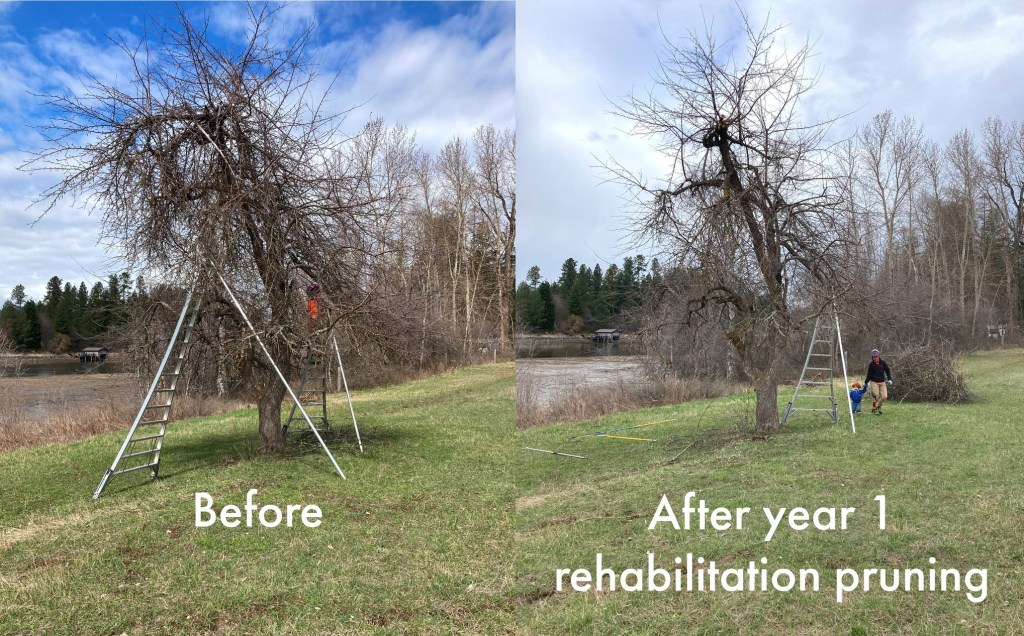
This is one of the most complex types of pruning, requiring specific training and experience in order to preserve the health of these often most precious heritage trees. Older trees are more sensitive to disturbance than their younger counterparts. Large old trees that have not been maintained require rehabilitation pruning if they become overgrown. The goal is to remove detrimental elements slowly over a period of years in a tree that has become too dense, shaded, and heavy. Overgrown trees usually have or are prone to large breaks that may compromise the main trunk. After identifying detrimental structural elements, we manage old and new growth over the course of a few years to promote a healthy new structure. All trees are different, but a good general rule of thumb is that it will take three years of this style of pruning for most trees to achieve the foundation of their new structure (when you should be able to readily see a big difference).
Trees Recovering from Excessive Pruning
Trees send out a stress response when too much of the tree has been removed at one time. The stress response is easy to see even for those with little or no experience with trees. This obvious reaction to stress is to send out upright sprouts either in the canopy (watersprouts) or at the base of the tree (suckers), (see photo below). These sprouts are not a healthy growth pattern and are a clear sign of tree stress. Once a tree is displaying a stress response, it takes years of a specific type of rehabilitative pruning from an experienced professional to interrupt the response. It’s best to avoid this in the first place by hiring a professional that guarantees the following on their estimate or quote for work:
1. The certified Arborist will take no more than 25% of the live foliage from the tree in a single pruning.
2. The certified Arborist will provide written pruning specifications which detail the number, diameter, and types of pruning cuts needed to achieve the pruning goals.

Once a stress response is induced, many people are inclined to remove all of the sprouts to improve the appearance of the tree. Removing all of the sprouts will take more vital energy from the tree, predisposing it to pest and disease issues and leading to further stress. If all the sprouts are removed year after year, the tree will likely succumb to a mortality spiral. Instead of removing all of the watersprouts, some of the sprouts must be left in the canopy each year, which works with the physiology of the tree to suppress additional sprouts from growing. We generally remove some of the sprouts, reduce the height of some of the sprouts, and leave alone up to one third of the sprouts to leave enough leaves on the tree so it may feed itself through photosynthesis. A tree that produces enough sugars will be able to allocate energy to defense (against pests and diseases), reproduction (making fruit), growth, and compartmentalization (closure of wounds).
 OOH LA LA Arboriculture & Fine Pruning